
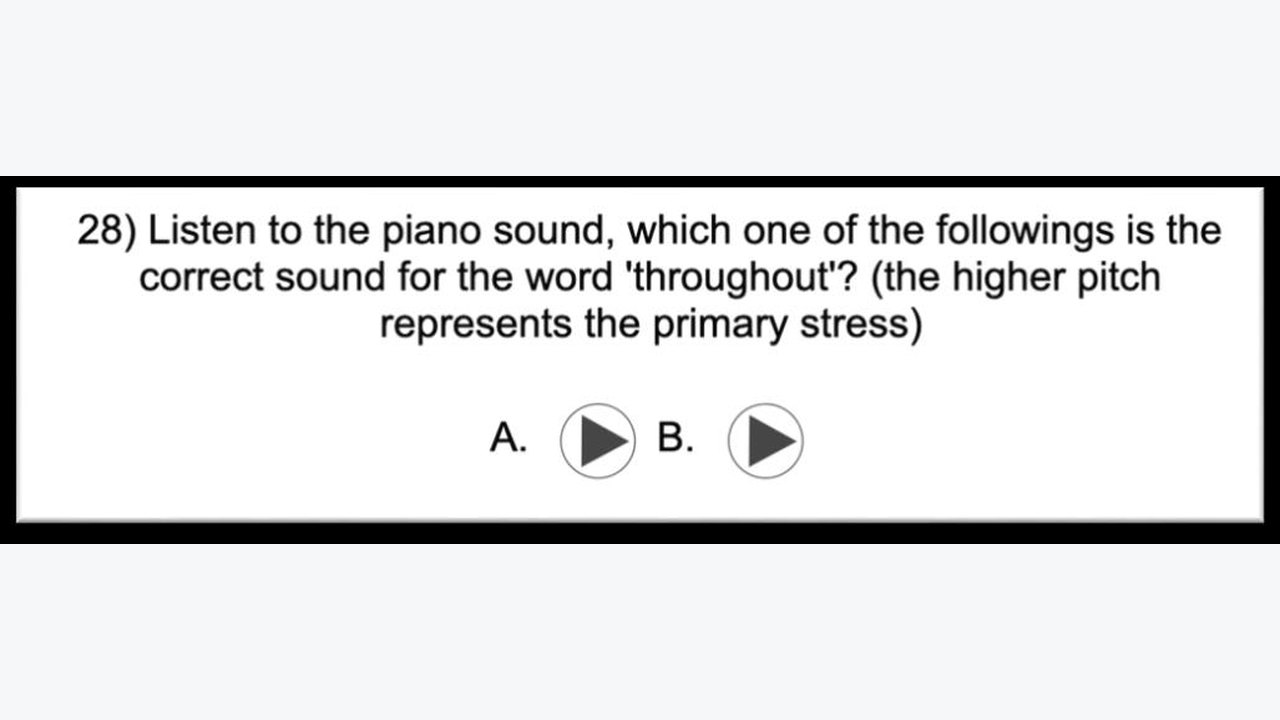
These flashcards focus on the rhythm inside English words. Learners hear piano notes that represent the stress pattern of a word: the higher pitch corresponds to the primary stress, while lower notes represent unstressed syllables. They then listen closely and match the sound to the word, turning a pronunciation pattern into a short listening puzzle.
The deck includes two complementary question types. One asks the learner to identify the word from the piano pattern; the other asks them to choose the correct sound pattern for a given word. Questions group words with the same number of syllables and give an explanation after the answer, so each attempt can lead back to the reason for the stress placement. The result is a compact listening exercise that can be repeated whenever a pattern remains uncertain.
How the listening puzzle works
- 45 multiple-choice word-stress questions
- Piano sounds that represent stressed and unstressed syllables
- Two task types: sound-to-word and word-to-sound matching
- Word groups organised by syllable count
- Answer explanations after each question
Evaluation
The report states that the deck was completed and user-tested. Participants described the questions and instructions as easy to understand and reported stronger awareness of word stress after using the exercises.